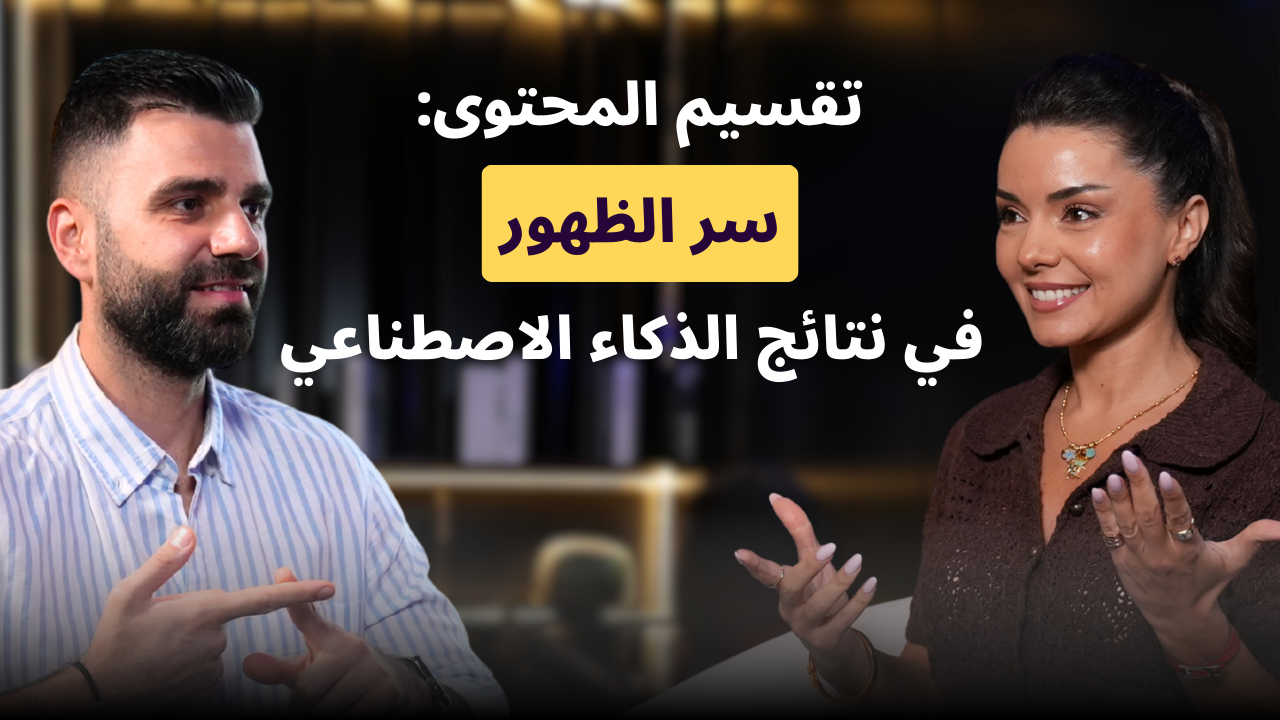

“Can you believe it, Ammar? We used to struggle to convince people that SEO matters. And today, some businesses tell us: we want to focus on growth, but by focusing on SEO only.”
Things have changed.
The user, however, hasn’t changed in essence. It’s the same person moving between Google, Instagram, LinkedIn, and now AI tools, using each platform to decide, compare, and choose.
The positive side? Finally, everyone recognizes the importance of SEO.
But here’s the real question:
Is SEO alone enough today?
Let’s explore.
Hello, I’m Basma. And I’m Ammar.
Our case today: The Role of SEO Within an Integrated Growth System in the Age of AI.
We’ve officially entered the age of AI search. Yet SEO remains a strong foundation.
The mistake is not in valuing SEO; it’s in isolating it from the bigger picture.
We are not downplaying the importance of SEO. We are, after all, an SEO agency. But the goal is clarity: SEO is a powerful foundation stone, not the entire building.
So why do we still consider SEO essential, even now?
At specific moments, users reveal clear intent.
Someone with a problem types a search query. At that moment, their need is exposed and explicit. Whoever appears intelligently in that exact moment wins, often significantly.
SEO is the channel that naturally and consistently captures this intent.
Search data from tools like Google Search Console shows us:
This language benefits far more than just SEO. It informs:
SEO becomes a lens into how the market thinks.
Over time, SEO builds durable assets:
These assets work for years. And importantly, they also feed other channels.
In short, SEO is not just traffic acquisition.
It is a system for understanding the market.
And in the age of AI, that role becomes more important, not less.
If SEO is foundational, why is it a mistake to rely on it alone?
This is the core issue.
Many businesses launch:
But if people don’t know these exist, they won’t search for them.
SEO helps users who already have awareness and are capable of typing a specific query.
It does not create that awareness.
That’s where:
Come in.
These channels create demand. SEO captures it.
Another important shift comes from AI search.
Today, users can ask a question and receive a summarized answer without ever visiting a website.
If your business model defines success only as website visits, you’re ignoring what’s happening.
You may:
Even if the user doesn’t click.
This means SEO’s role expands beyond traffic. It contributes to context, brand presence, and authority.
SEO becomes part of the ecosystem, not just a click engine.
Relying solely on SEO is risky.
What happens if:
If your entire business stands on one leg, it becomes vulnerable.
And this principle applies universally.
If you rely only on ads, risky.
Only on social media is risky.
Only on SEO, equally risky.
Resilience requires integration.
Growth operates across three layers.
This is where:
introduce the brand.
They generate awareness.
They tell stories.
They humanize the brand.
They make people care.
This is where SEO becomes critical.
When people search for:
SEO ensures you appear at the right time.
Deep content turns curiosity into:
Here, SEO collaborates with:
to reinforce visibility and credibility.
Growth doesn’t stop at acquisition.
This layer includes:
SEO feeds this layer with:
These materials strengthen retention and lifetime value.
AI has expanded SEO’s role.
SEO now functions as a knowledge layer.
Your website content serves:
When content is structured, well-organized, and clearly defined, especially when built on strong entities and structured properly, it serves traditional SEO and increases the chances of:
SEO also feeds internal AI systems.
If a company runs:
What powers these tools?
Questions.
Queries.
Website content.
FAQs.
Questions are no longer just marketing tools; they’re part of the company’s internal knowledge architecture.
If you want to know whether your SEO operates in isolation or within an integrated growth system, ask yourself:
If you can answer these clearly, you’ll know whether your SEO is integrated or isolated.
Our case today asked:
Is SEO alone enough in the age of AI?
From the SEO perspective:
From a growth-system perspective:
So the final judgment?
SEO is still necessary.
SEO is still foundational.
SEO is a natural extension of brand identity.
But it is not the only pillar.
Today, SEO’s true role is:
While working in alignment with:
The smart brand no longer asks:
“SEO or other growth channels?”
It asks:
“Is SEO playing its full role within an integrated growth system?”
That’s our case for today.
Now tell us:
Do you rely on one channel in your strategy?
Or do you operate across an integrated system?
See you in the next case.
Podcast
Ready to grow with intention and performance in mind
We design solutions that move you forward, and deliver measurable impact.