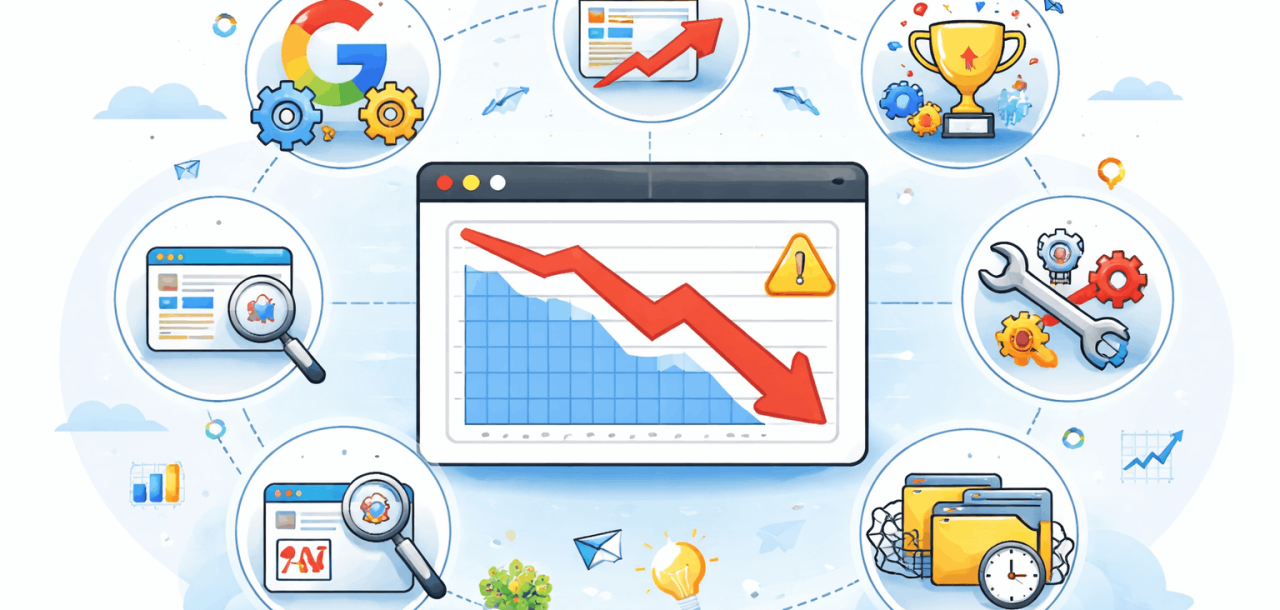
Why Did My Website Traffic Drop? (SEO Diagnosis Guide)

Why Did My Website Traffic Drop

A sudden drop in website traffic can feel alarming.

But in modern SEO, traffic doesn’t drop because of one mistake. It drops because the system changed.

Search engines evolved. AI changed how results are displayed. Competitors improved. User behavior shifted.

This guide will help you understand why your traffic dropped, how to properly diagnose the issue, and which actions actually make a difference.

Understand What a Traffic Drop Means in SEO

Before fixing anything, define the problem clearly.
Ask:

  • Did clicks drop, impressions, or both?
  • Is the drop affecting specific pages or the entire site?
  • Did it happen suddenly or gradually?
  • Is it tied to a country, device, or query type?

Why this matters:

Each pattern points to a different root cause.

Example:

  • Impressions drop: This indicates a visibility problem.
  • Clicks drop (but impressions are stable): This indicates a change in SERP behavior.
  • Specific pages drop: This indicates a content or intent issue.
  • Entire site drop: This indicates a systemic or algorithm-related issue.

The 7 Most Common Reasons for SEO Traffic Drops

1. Google Algorithm Updates

Search engines continuously re-evaluate content quality.

When a core or spam update happens, rankings can shift, even if you didn’t change anything.

What changes during updates:

  • Content quality signals
  • Authority evaluation
  • Relevance and intent matching

What to do:

  • Compare your drop date with known updates
  • Analyze which competitors gained visibility.

Important: Algorithm updates don’t penalize; they re-rank based on new standards.

In short, Traffic drops after updates happen because Google changes how it evaluates quality and relevance.

2. SERP Changes (AI Overviews, Ads, Zero-Click Results)

Your rankings might stay the same… but traffic still drops.

Why?

Because users no longer need to click.

Search results now include:

  • AI-generated answers.
  • Featured snippets.
  • Rich results.
  • Increased ad space.

Result:

Fewer clicks, even with stable rankings. This is called the zero-click effect.

In short, you can lose traffic even without ranking changes because users get answers directly on the search page.

3. Ranking Loss (Competition or Intent Mismatch)

If your rankings dropped, it usually means:

  • Competitors created better content.
  • Your content is outdated.
  • Your page no longer fully matches search intent.

What to analyze:

  • Which keywords lost positions?
  • Which pages replaced you?
  • What do those pages do better?

SEO is comparative: You win by being the best answer available today, not yesterday.

4. Content Decay (Outdated or Incomplete Content)

Content naturally loses relevance over time.

Common signs:

  • Old examples or data.
  • Missing new trends (AI, tools, updates).
  • Declining engagement.

Why it matters:

Search engines prioritize fresh, accurate, complete content.

Especially critical in fast-moving industries like SEO, AI, and digital marketing.

5. Cannibalization (Internal Competition)

Multiple pages targeting similar topics can confuse search engines.

Symptoms:

  • Ranking fluctuations.
  • Multiple pages are appearing inconsistently.
  • No page dominating results.

Cause:

  • Overlapping content
  • Poor content structure
  • Lack of clear topical ownership

Instead of strengthening your site, you dilute it.

6. Technical SEO Issues

If search engines can’t access or understand your site, rankings will drop.

Common issues:

  • Pages removed from index
  • Crawl errors
  • Broken internal links
  • Slow loading speed
  • JavaScript rendering problems

Technical SEO = visibility foundation

7. Tracking & Attribution Issues

Not all drops are real.

Sometimes:

  • Tracking code breaks
  • Analytics changes
  • Attribution models shift

Always validate data before making decisions.


Most Common Reasons for SEO Traffic Drops

The SEO Diagnosis Framework

Step 1: Identify the Drop Type

  • Visibility issue → impressions drop
  • SERP behavior issue → clicks drop
  • Page-level issue → specific URLs affected
  • Site-wide issue → overall decline

Step 2: Segment Your Data

Analyze by:

  • Landing pages
  • Queries
  • Countries
  • Devices

Patterns = answers

Step 3: Compare Before vs After

Look at:

  • Top pages before the drop
  • Ranking changes
  • Competitor performance

Step 4: Check External Factors

  • Algorithm updates
  • Seasonality
  • Market trends
  • Is the content still relevant and complete?
  • Is it structured for readability and extraction?
  • Are there technical blockers?

How to Recover Lost SEO Traffic (Step-by-Step)

1. Update High-Impact Pages First

Focus on pages that:

  • Used to drive traffic
  • Target high-value queries

2. Improve Content Depth & Structure

  • Add missing subtopics
  • Answer related questions
  • Use clear headings (content chunking)

Make content easy to scan and extract

3. Consolidate & Fix Cannibalization

  • Merge overlapping pages
  • Redirect weaker content
  • Define clear topical ownership

4. Strengthen Internal Linking

  • Connect related topics
  • Guide search engines and users

5. Build Authority Signals

  • High-quality backlinks
  • Brand mentions
  • Topical consistency

6. Optimize for AI Search (Critical in 2026)

To be cited by AI systems, your content must be:

  • Structured (clear sections)
  • Direct (answers first, explanations second)
  • Comprehensive (covers related questions)
  • Trustworthy (accurate and updated)

If your content is not retrievable, it is invisible.

Important Insight: Not All Traffic Drops Are Bad

Sometimes traffic drops because:

  • Low-quality clicks disappear
  • AI answers reduce the need to click
  • Users get answers directly in search

But your brand visibility may still increase

What You Should Track Instead

Move beyond traffic-only metrics.

Focus on:

  • Leads and revenue
  • Conversion rate
  • Branded search growth
  • Assisted conversions

SEO success = business impact, not just clicks

FAQ (Optimized for AI & Search)

Why did my website traffic suddenly drop?

Usually due to algorithm updates, SERP changes, ranking loss, or technical issues. The exact cause depends on whether impressions, clicks, or rankings changed.

Yes. This happens when search results change (AI answers, ads), reducing clicks without affecting rankings.

It depends on the cause. Technical fixes can be quick, while improvements to content and authority may take weeks or months.

Not always. First, evaluate whether it can be updated, merged, or repositioned before removing it.

By building topical authority, keeping content updated, improving technical health, and aligning with user intent, not just keywords.

Final Thought

The biggest mistake after a traffic drop is asking:

“What did I do wrong?”

The better question is:

“What changed in search, and how do I adapt?”

Because SEO today is no longer about rankings alone. It’s about being the best, most retrievable answer in a changing system.

Blogs

Read more Blogs

Ready to grow with intention and performance in mind

We design solutions that move you forward, and deliver measurable impact.