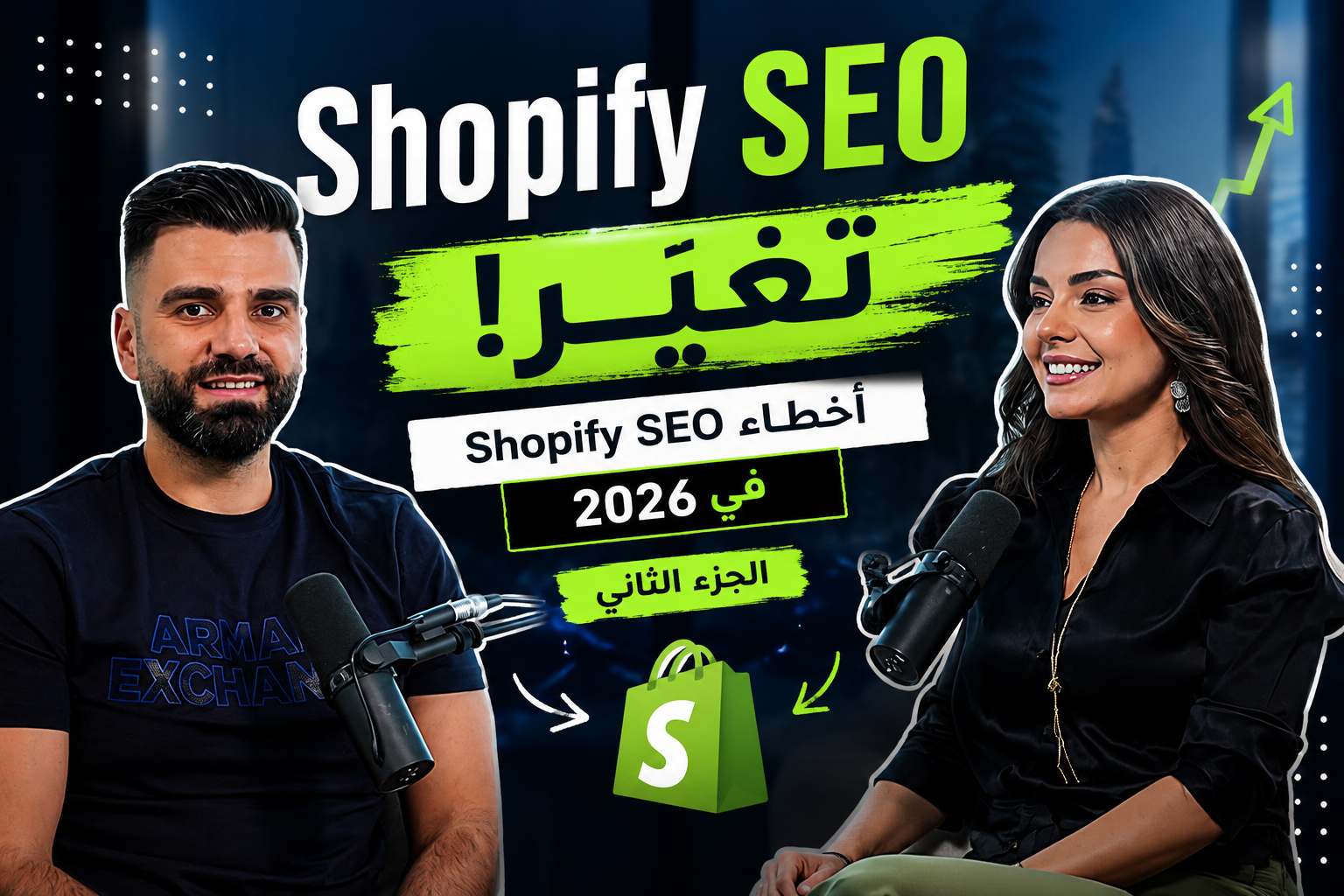

This is part three of our Shopify SEO series, where we continue answering the questions store owners ask most often.
In previous discussions, we covered Google, AI search, content, product and collection pages, technical SEO, and many of the foundations that help a Shopify store become visible.
But there is an important point we need to clarify:
Most Shopify store owners do not wake up thinking:
“I hope I rank number one on Google today.”
What they actually care about is something much more practical:
Is SEO generating sales and profitable growth?
Many businesses still measure SEO success mainly through:
But these metrics alone do not tell the full story.
A store may generate 100,000 organic visits per month and still struggle to make a meaningful profit.
Another store may receive only 20,000 visits and generate significantly more revenue.
So the real goal of SEO is not simply traffic.
It is growth, revenue, and profit.
For most Shopify and e-commerce stores, two page types generate the largest share of organic traffic and sales:
However, each plays a different role in the customer journey.
Collection pages often attract users while they are still comparing options.
They may know the product category they want, but they have not yet decided which specific product to purchase.
For example, someone searching for:
is often still evaluating their choices.
Collection pages help users explore these options.
They are an important bridge between search and product discovery.
Product pages usually reach users much closer to the purchase decision.
By the time someone lands on a specific product page, they often already know what they want.
They may simply need the final piece of information before buying.
That is why strong product pages can turn potential buyers into actual customers.
Many store owners assume:
“Blogs don’t generate direct sales, so why invest in them?”
It is true that a blog may not always generate an immediate transaction.
But that does not mean it has no impact on revenue.
For many customers, the first interaction with a brand happens through an article.
That article may be:
The customer discovers the brand, learns from it, begins trusting it, and later moves toward collection pages and product pages before purchasing.
That is why successful Shopify stores do not think about every page independently.
They think about the full customer journey:
Educational content → Collection pages → Product pages → Checkout
A blog helps create and support the demand that product and collection pages eventually convert.
This is one of the most common questions store owners ask.
The answer depends on the objective.
Paid advertising is usually the faster option.
You can launch a campaign and begin generating:
relatively quickly.
SEO works differently.
It requires investment and time.
But once you have built:
those assets can continue generating traffic and sales over the long term.
That is why SEO and paid advertising should not necessarily be positioned against each other.
The strongest e-commerce strategies often use both.
Paid advertising generates immediate demand.
SEO creates a sustainable organic channel.
Paid advertising can be extremely effective.
But it comes with one obvious limitation:
You pay for every click.
When the budget stops, the traffic stops.
SEO also requires investment in strategy, content, technical improvements, and expertise, but once the organic foundation is built, it can continue generating sales without paying for every individual visit.
This helps reduce the pressure on the marketing budget.
The goal is not necessarily to eliminate advertising.
The goal is to avoid becoming completely dependent on it.
Many store owners open Google Search Console, look at keyword rankings, and assume they are measuring SEO performance.
But rankings are only a means to an end.
They are not the final goal.
There are several more meaningful metrics Shopify stores should track.
Traffic still matters.
But instead of measuring only the number of visits, ask:
Ten thousand qualified visits may be significantly more valuable than one hundred thousand irrelevant ones.
How many purchases or meaningful actions are being generated through organic search?
This helps connect SEO activity directly to business results.
Traffic can increase while revenue remains flat.
When that happens, the store needs to understand why.
Perhaps:
Revenue gives SEO context.
Ask:
What percentage of users arriving through organic search actually purchase?
This connects SEO directly to CRO and user experience.
More traffic without improved conversion does not necessarily mean stronger business performance.
Ultimately, a store owner needs to know:
Is the money we invest in SEO generating a return?
The costs may include:
Compare these costs against the revenue generated from the organic channel.
That gives you a clearer picture of the return on investment.
There is now another metric that Shopify stores should increasingly monitor:
Visibility in AI-powered search.
For example:
Today, visibility across AI-powered discovery environments has become an important part of digital marketing measurement.
At its simplest, SEO ROI requires comparing what the organic channel generates against what you invested in it.
Start with the revenue coming from SEO.
Then calculate the investment required to generate it.
This may include:
But there is an important complication.
SEO does not always receive full credit for the revenue it influences.
Not everyone who discovers your store through Google buys immediately.
A user might:
If your attribution model gives all the credit to the final interaction, SEO appears to have contributed nothing.
But SEO may have been what started the customer journey in the first place.
That is why relying exclusively on last-click attribution can be unfair to organic search.
SEO often plays an important role earlier in the customer journey.
When measuring ROI, businesses should consider the full path to purchase—not just the final click.
This is another question we hear constantly:
“What conversion rate should my Shopify store have?”
There is no universal number.
Conversion rates depend on many factors, including:
For one store, a 1% conversion rate may be excellent.
For another, 5% may only be acceptable.
That is why comparing your conversion rate with another store is not always useful.
Instead of obsessing over industry benchmarks, look at your own trend.
Ask:
If your organic visits and conversion rate are improving together, it is a strong indication that:
are working in alignment.
This is far more meaningful than comparing your store blindly with a competitor.
Not all search queries bring the same type of visitor.
Some searches have much stronger commercial intent.
High-purchase-intent terms often include words such as:
Specific searches may also include:
These queries usually come from users who are much closer to making a purchasing decision.
No.
Informational searches play a very important role too.
Someone reading:
may not purchase today.
But that content helps build trust and introduces the brand earlier in the customer journey.
A strong Shopify SEO strategy therefore covers both:
Create commercial and transactional content.
Create informational and educational content.
The goal is to be present throughout the full customer journey.
Many Shopify stores are facing increasingly expensive paid advertising costs.
SEO can help reduce this dependency.
With paid advertising, every visit comes with a cost.
With organic search, there is still an investment, but you do not pay for every click individually.
Once you build:
Those assets can continue generating visits and sales over time.
As organic sales grow, the average cost of acquiring a customer can decrease.
This is important.
SEO is not about saying:
“Stop advertising.”
The objective is to build a healthier channel mix.
When a store has strong organic visibility, it has more flexibility. It is no longer completely dependent on paid traffic for every sale. This makes growth more resilient and sustainable.
This is perhaps the most important lesson.
SEO should not be evaluated only through:
Instead, measure:
When store owners start looking at SEO through these metrics, they stop treating it as a standalone marketing task.
They start treating it as part of the growth strategy.
Shopify SEO is not ultimately about rankings.
Rankings are a tool.
Traffic is a tool.
Keywords are a tool.
The real objective is to build a channel that consistently brings:
Collection pages help customers compare.
Product pages help them buy.
Educational content builds trust before the purchase.
Paid advertising can generate immediate sales.
SEO builds long-term demand capture.
And both can work together.
The Shopify stores that get the most value from SEO are not necessarily the ones with the highest rankings.
They are the ones that can connect organic visibility to revenue, profitability, and sustainable growth.
That was our topic for today.
If you have any questions, leave them in the comments. See you in the next episode.
Podcast
Ready to grow with intention and performance in mind
We design solutions that move you forward, and deliver measurable impact.
