

What Makes Your Website Worth Visiting in the Age of AI Search
What Makes Your Website Worth Visiting in the Age of AI Search Your website is worth visiting when it offers
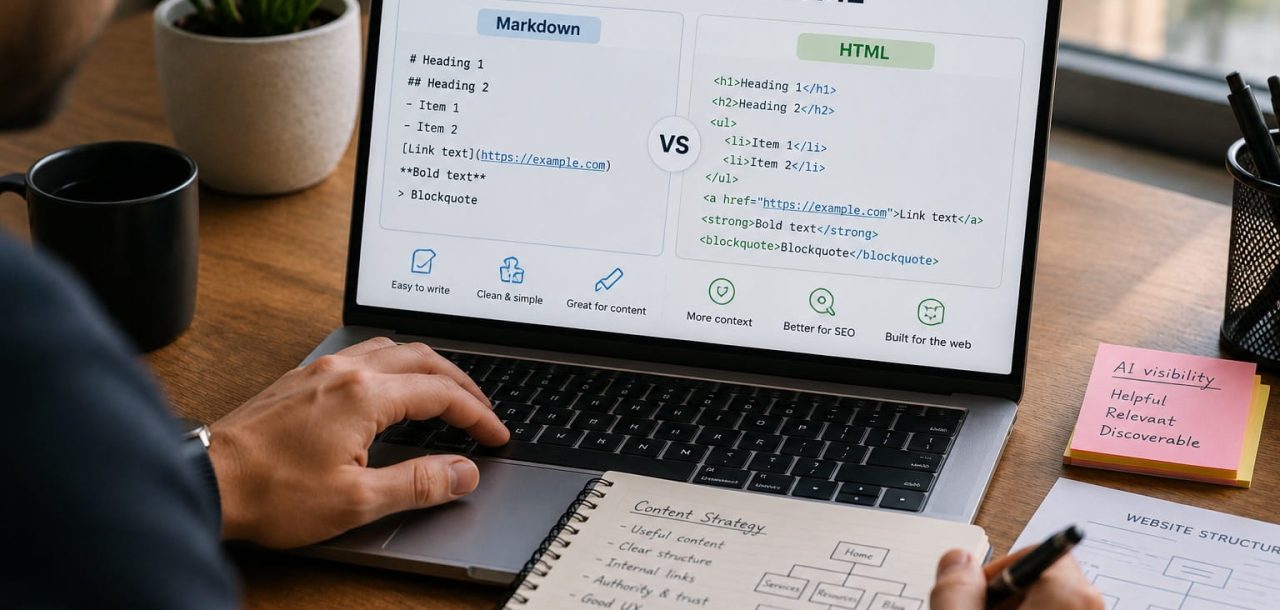
As AI-powered search tools continue to grow, many website owners are asking whether they should create Markdown versions of their content, publish llms.txt files, or make other changes to help AI systems understand their websites.
The discussion has become increasingly common as platforms such as ChatGPT, Perplexity, Claude, Gemini, and AI-powered search experiences continue to reshape how people discover information online.
Recently, Google’s Search Relations team, including John Mueller and Martin Splitt, discussed this exact topic during a Search Off The Record podcast episode. Their conversation offered one of the clearest explanations yet of how Google views Markdown, HTML, AI discoverability, and emerging AI-focused content formats.
The takeaway may surprise many marketers, SEOs, and website owners.
Despite the growing hype around Markdown and llms.txt, Google suggests that neither format provides a meaningful advantage for search visibility or AI discoverability. Instead, the fundamentals remain largely unchanged: create content that is easy to crawl, easy to understand, and genuinely useful.
The rise of AI search has created a wave of new recommendations, theories, and optimization tactics.
One of the most discussed ideas is that websites should provide content in Markdown format because large language models (LLMs) are supposedly more comfortable with it than with traditional HTML.
At the same time, new concepts such as llms.txt have gained attention across developer communities, AI forums, and technical SEO discussions. Many advocates argue that AI systems can process Markdown more efficiently because it is cleaner, simpler, and contains less visual clutter than HTML.
As a result, some website owners have started asking questions such as:
The popularity of Markdown comes largely from its simplicity—not because search engines or AI systems require it.
Understanding that distinction is important.
Markdown is a lightweight markup language designed to make content creation easier.
Instead of writing complex HTML code, authors can use simple symbols to create headings, lists, links, and formatting.
For example:
# Main Heading
## Subheading
– Item One
– Item Two
[Link](https://example.com)
Markdown is widely used across:
One important detail often gets overlooked:
Markdown is usually an authoring format rather than a publishing format.
In many cases, content is written in Markdown and then automatically converted into HTML before being published on a website.
Users see HTML pages. Search engines crawl HTML pages. The Markdown itself often remains behind the scenes.
The argument for Markdown usually centers around three perceived advantages.
Markdown naturally organizes content through:
This creates a clear hierarchy that can be easy for both humans and machines to follow.
Unlike HTML pages, Markdown files typically exclude:
The result is a streamlined document focused almost entirely on content.
Raw Markdown is generally easier for humans to read than raw HTML source code.
Many developers argue that AI systems may also benefit from this simplicity.
At first glance, these arguments seem logical.
However, Google’s position suggests that these perceived benefits do not create a meaningful discoverability advantage.
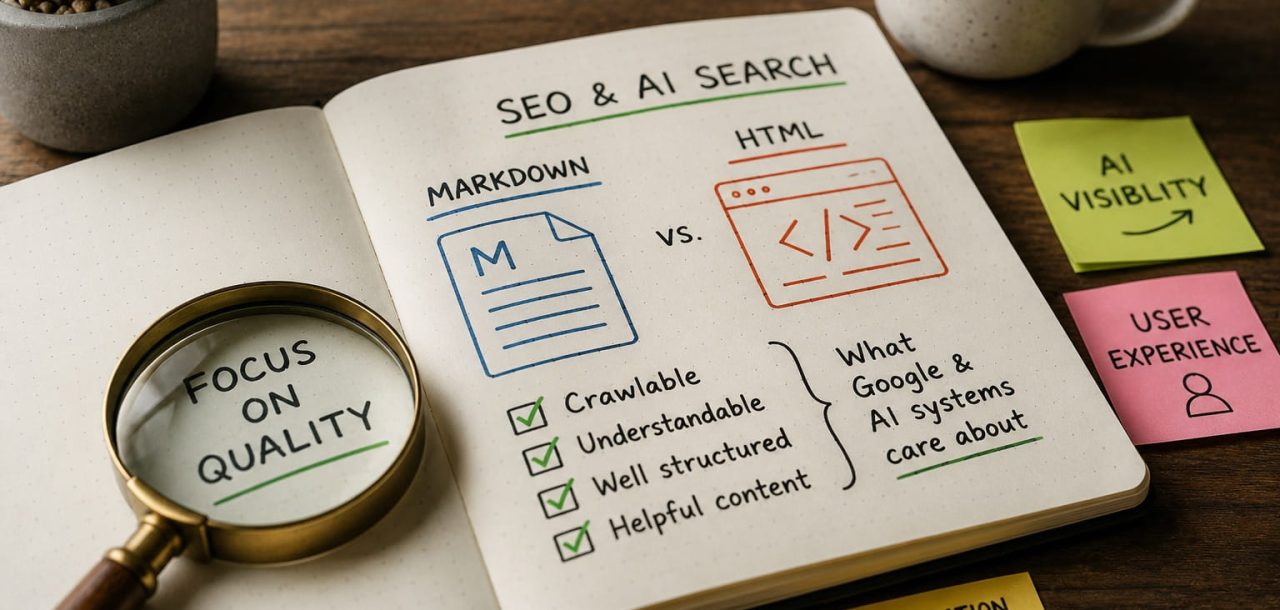
One of the most important insights from Google’s discussion is that search engines already understand HTML extremely well.
Google’s systems have been processing HTML pages for decades.
Extracting content, understanding page structure, identifying headings, interpreting links, and evaluating relationships between pages are all mature capabilities.
From Google’s perspective, extracting useful information from HTML is essentially a solved problem.
This is important because many assumptions about Markdown are based on the idea that HTML somehow creates barriers for AI systems.
Google does not see it that way.
The web is built on HTML.
Search engines expect HTML.
Browsers render HTML.
Most AI systems that access websites are already trained on massive amounts of HTML-based content.
The infrastructure supporting discovery, crawling, indexing, and content understanding is fundamentally designed around HTML.
Perhaps the most important takeaway is that Google provided no indication that Markdown improves:
Simply changing formats does not solve visibility challenges.
If your goal is better SEO performance or stronger AI visibility, Google’s message is clear:
Focus on creating excellent HTML pages rather than replacing them with Markdown.
The format itself is rarely the limiting factor.
One of the most overlooked aspects of this discussion is that HTML often provides significantly more context than Markdown.
Many people view HTML as clutter and Markdown as clean.
But search engines and AI systems do not necessarily see it that way.
HTML contains valuable signals that help machines understand how a website is organized.
These include:
Website navigation reveals relationships between sections and topics.
For example:
These relationships help search engines understand topical relevance and content hierarchy.
Internal links help crawlers discover additional content and understand connections between pages.
Strong internal linking remains one of the most effective ways to improve crawlability and content discoverability.
HTML helps communicate:
This context is essential for both search engines and AI systems attempting to understand a website.
AI systems increasingly rely on entity relationships and information architecture.
HTML often contains valuable contextual clues about how information connects across a site.
Removing these signals in pursuit of a “cleaner” format can actually reduce understanding rather than improve it.
In other words, the additional information contained within HTML is often a strength, not a weakness.
Another trend receiving significant attention is llms.txt.
The concept is simple.
A website publishes a dedicated file to help AI systems understand its content and key resources.
Supporters often describe it as similar to robots.txt or a sitemap, but designed specifically for AI agents and large language models.
The idea has generated substantial interest because it appears to offer a direct way to communicate with AI systems.
However, Google’s discussion highlights an important distinction.
These are two completely different problems.
Discovery means helping an AI system find your website in the first place.
Navigation means helping an AI system understand your website after it has already found it.
According to Google’s perspective, llms.txt may potentially assist with navigation or interpretation.
It is not a discovery mechanism.
Publishing an llms.txt file does not automatically make a website more visible to search engines, AI crawlers, or AI search platforms.
That distinction is critical because many businesses mistakenly assume that llms.txt is an AI SEO shortcut.
At least today, there is little evidence supporting that assumption.
None of this means Markdown is useless.
In fact, Markdown can be extremely valuable in the right situations.
It is particularly useful for:
In these environments, Markdown offers significant workflow advantages:
Many successful documentation websites use Markdown as their primary content creation format.
The key distinction is that Markdown supports content production workflows.
It does not automatically improve discoverability.
For most businesses running:
There is little reason to adopt Markdown purely for AI Search Optimization.
This is where the conversation becomes most interesting.
The AI Search challenge is not HTML.
The AI Search challenge is poor content quality and poor website structure.
Businesses often look for technical shortcuts because they seem easier than improving the fundamentals.
But visibility in both traditional search and AI search increasingly depends on factors such as:
Can machines understand how your content is organized?
Does your content provide unique insights, expertise, and original value?
Can crawlers easily discover related content?
Are headings, sections, and relationships clearly defined?
Does the content demonstrate real experience and subject matter expertise?
Can search engines and AI systems clearly identify the people, organizations, products, services, and topics discussed?
Can search engine crawlers and AI agents efficiently access and process your content?
These are the areas where AI visibility is won or lost.
Not through file format changes.
The websites most likely to succeed in AI-powered search are not necessarily the ones experimenting with Markdown or llms.txt.
They are the ones building clear, trustworthy, well-structured knowledge ecosystems that are easy for both humans and machines to understand.
Final Verdict
So, does Markdown help SEO?
Not directly.
Does Markdown improve AI discoverability?
According to Google’s latest discussion, there is no evidence that it does.
Use Markdown if:
Do not adopt Markdown because you expect:
The broader lesson is simple.
HTML remains the foundation of search and AI discovery.
Modern search engines, AI crawlers, and large language models already understand HTML exceptionally well.
Instead of chasing new formats, businesses should focus on what actually drives visibility: strong information architecture, semantic structure, internal linking, crawlability, expertise, and genuinely useful content.
Those fundamentals matter far more than whether your content is written in HTML, Markdown, or any future format that emerges.
Wondering whether your website is truly ready for AI-powered search?
At WeTakTik, we help businesses improve visibility across Google Search, AI Overviews, ChatGPT, Perplexity, and emerging AI search platforms by focusing on what actually matters, not chasing every new trend.
From technical SEO and content strategy to AI Search Optimization and entity-driven visibility, we help brands build the foundations that both search engines and AI systems trust.
Blogs
What Makes Your Website Worth Visiting in the Age of AI Search Your website is worth visiting when it offers

What does AI watermarking mean for SEO and content? As governments and technology companies seek out better methods for identifying
Ready to grow with intention and performance in mind
We design solutions that move you forward, and deliver measurable impact.