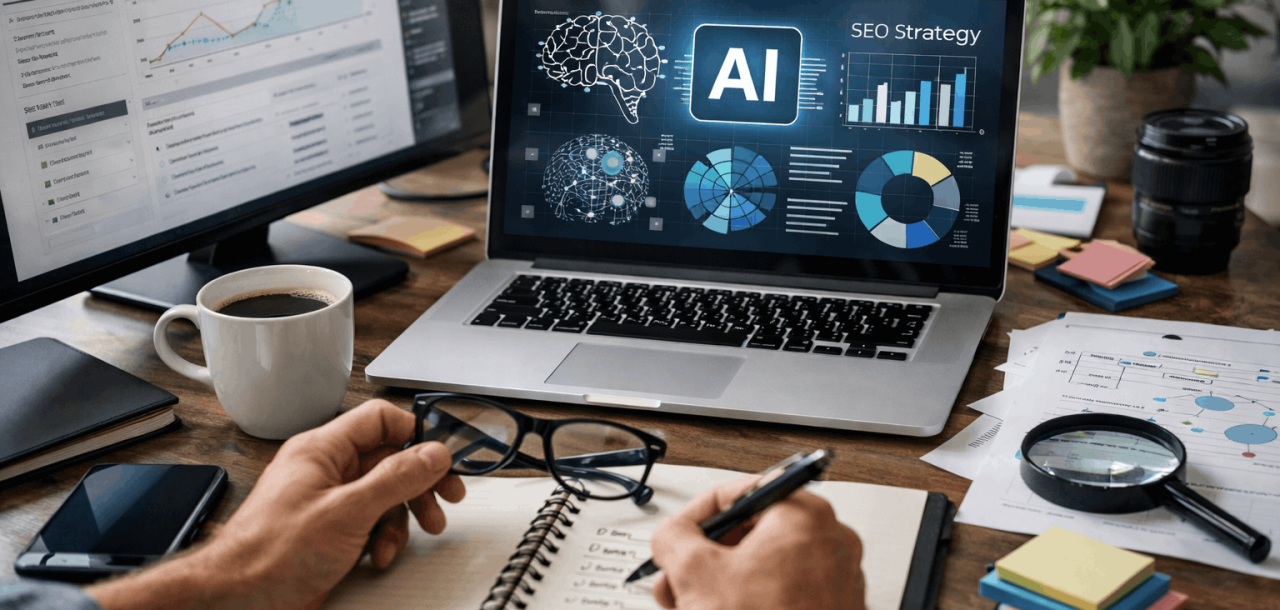
How Smart SEOs Use AI Without Losing Strategic Thinking

How Smart SEOs Use AI Without Losing Strategic Thinking

AI has changed SEO. But it hasn’t replaced strategy.

The difference between generic AI-driven SEO and high-impact AI-powered SEO is not the tool; it’s the thinking behind it.

Smart SEOs don’t use AI to replace judgment. They use it to amplify structured thinking.

This article explains how SEO professionals can use AI responsibly, strategically, and effectively, without losing competitive advantage.

Why AI Is Reshaping SEO, But Not Replacing It

AI tools can now:

  • Generate outlines in seconds.
  • Cluster keywords automatically.
  • Draft articles.
  • Suggest content structure.
  • Analyze SERPs.

But they cannot:

  • Understand your revenue model.
  • Prioritize high-leverage pages.
  • Define brand positioning.
  • Make risk-based trade-offs.
  • Own performance outcomes.

AI increases speed. Strategy determines direction. Without direction, speed scales mediocrity.

Key insight: AI improves execution efficiency, not strategic judgment.

What Strategic Thinking in SEO Actually Means

Strategic SEO is not content production. It is decision-making under uncertainty.

It includes:

  • Aligning search intent with business objectives.
  • Mapping content to conversion pathways.
  • Identifying competitive differentiation.
  • Structuring topical authority ecosystems.
  • Managing trust, proof, and uncertainty gaps.

AI can assist with analysis. But prioritization, trade-offs, and positioning remain human responsibilities.

Strategic thinking in SEO = choosing what matters, not just producing more.

Smart Ways SEOs Use AI

The 5 Smart Ways SEOs Use AI

AI adds real leverage when used intentionally.

1. Research Amplification (Not Replacement)

AI is highly effective at accelerating research.

Smart SEOs use it to:

  • Cluster-related search intents.
  • Identify recurring themes in SERPs.
  • Extract entity relationships.
  • Simulate different user personas.
  • Surface hidden objections.

However, every insight must be validated against:

  • Real SERP behavior.
  • Google Search Console data.
  • Conversion data.
  • Competitive landscape.

AI surfaces patterns. The strategist selects which patterns matter.

2. AI as a Strategic Critic

Instead of asking AI to “write the article,” smart SEOs use it to critique their thinking.

They ask:

  • What assumptions are weak?
  • Where is the reasoning incomplete?
  • What objections are unaddressed?
  • What competing angle could challenge this?

This transforms AI from a content generator into a thinking partner. It improves depth, clarity, and completeness, not just volume.

3. Structural Optimization & Content Clarity

Search engines and AI systems reward clarity.

AI can help improve:

  • Content chunking.
  • Logical progression.
  • Internal linking suggestions.
  • Section completeness.
  • Redundancy removal.

Clear structure improves:

  • Crawlability.
  • Comprehension.
  • Information extraction.
  • Featured snippet eligibility.
  • AI citation potential.

AI supports structure. Strategy defines substance.

4. AI Search Simulation

AI-powered search environments summarize content.

If your page cannot survive summarization, it may not be selected or cited.

Smart SEOs use AI to:

  • Simulate assistant-style answers.
  • Identify missing context.
  • Detect uncertainty gaps.
  • Test clarity and completeness.

This is proactive optimization for AI search visibility. It turns AI into a testing environment, not a writing machine.

5. Execution Efficiency

AI is ideal for repeatable execution tasks such as:

  • Drafting meta descriptions.
  • Creating schema markup drafts.
  • Formatting content.
  • Summarizing reports.
  • Cleaning structured data.

These tasks require precision, not strategic judgment. Automation belongs in mechanics, not direction.

Where AI Should Not Lead

Smart SEOs draw clear boundaries.

AI should not define:

  • Business priorities.
  • Market positioning.
  • Brand narrative.
  • Competitive strategy.
  • Conversion psychology.
  • Risk tolerance.

These require contextual understanding, experience, and accountability.

AI informs decisions. It does not own them.

The Difference Between SEO Operators and SEO Strategists

AI has widened the industry gap.

Operators:

  • Ask AI what to do.
  • Follow output without filtering.
  • Produce generic structures.
  • Confuse productivity with impact.

Strategists:

  • Define objectives first.
  • Design prompts intentionally.
  • Validate outputs critically.
  • Integrate real data.
  • Focus on leverage, not volume.

AI does not replace strategists. It amplifies them.

Prompt Engineering as Structured Thinking

Prompt engineering in SEO is not about clever phrasing.

It is about clarity of thought.

A high-quality SEO prompt includes:

  1. Clear business context.
  2. Defined audience and search intent.
  3. Constraints and limitations.
  4. Evaluation criteria.
  5. Desired output structure.

If the thinking is vague, the output will be generic.

Good prompts reflect a structured strategy.

Prompt engineering is clarity engineering.

Practical Checklist: How to Use AI Without Losing Strategic Control

Use this framework:

Before Using AI

  • What business objective does this task support?
  • What data validates this direction?
  • What risk exists if this is wrong?

While Using AI

  • Provide full context.
  • Specify constraints.
  • Ask for reasoning, not just output.

After Using AI

  • Validate against real search data.
  • Filter aggressively.
  • Add original insight.
  • Refine structure manually.

AI is a multiplier; multipliers only work when the base signal is strong.

Final Takeaway

AI will not level the SEO field.

It will widen the gap between:

  • Those who think strategically.
  • And those who automate unthinkingly.

The future of SEO is not “AI-driven“; it is strategy-driven and AI-assisted.

Smart SEOs don’t lose strategic thinking; they design it into every prompt.

Blogs

Read more Blogs

Ready to grow with intention and performance in mind

We design solutions that move you forward, and deliver measurable impact.